Miniature Herefords No longer selling these. Go to the NZ Hereford association website for a list of members.

|
Riverview Minature Herefords is situated on an 8 hectare block in Tuakau, about 65Km south of Auckland central. The farm extends down to the Waikato River to the south with some good flat ground but also steep country. We also have a direct marketing business, Hunkin Garden Products Ltd that we run from the farm. By Graham Hunkin |
||||
|
|
||||
 There were plenty of different breeds to choose from
but having had some experience with all sorts of mixes of breeds
the Hereford appealed. Miniature Herefords, which are a smaller
chunkier version of the larger Hereford, like their larger cousins,
have a good temperament, essential for a small block. They forage
well and don't seem to be affected too adversely by hills and the
poorer feed that grows on them. Miniatures do grow horns, (polled
animals are not allowed for registration yet) but horns are easily
removed when young. If you are thinking of horned animals, forget
it. They may look great, but they are dangerous, and there are plenty
of injured farmers around to prove it. Even if your animal is quiet,
they only have to just have a bad day, or perhaps turn their head
for an affectionate scratch, to hurt you. You just don't want
horned animals on a small block. If you still have doubts, ask
your vet. My personal opinion is that it is only a matter of time
before OSH will have all animals dehorned as mandatory. There were plenty of different breeds to choose from
but having had some experience with all sorts of mixes of breeds
the Hereford appealed. Miniature Herefords, which are a smaller
chunkier version of the larger Hereford, like their larger cousins,
have a good temperament, essential for a small block. They forage
well and don't seem to be affected too adversely by hills and the
poorer feed that grows on them. Miniatures do grow horns, (polled
animals are not allowed for registration yet) but horns are easily
removed when young. If you are thinking of horned animals, forget
it. They may look great, but they are dangerous, and there are plenty
of injured farmers around to prove it. Even if your animal is quiet,
they only have to just have a bad day, or perhaps turn their head
for an affectionate scratch, to hurt you. You just don't want
horned animals on a small block. If you still have doubts, ask
your vet. My personal opinion is that it is only a matter of time
before OSH will have all animals dehorned as mandatory. |
||||
|
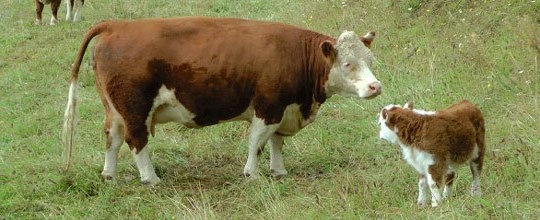
One other big plus with the Hereford is that the white face is the dominant gene so if you cross breed you should always get a white-faced animal. These always fetch the best prices at the sale yards. So what are Miniature Herefords. Well they are not really miniature, they are about 60% of the size of a normal Hereford. However there are some small lines and our own bull "Riverview Robbie" is only a little over a metre high at the hip at 16 months old. They are true Herefords and the larger minis are probably more like the original animal that came out of Herefordshire in the 1700s to the USA than the larger Hereford we see today. Herefords are one of the main bull breeds used by dairy farmers over their cows. The animal is smaller than the Friesan, so calving is easier. The Hereford is a meat animal, so you get a good cross-bred animal, the size of the Friesan with the beef of the Hereford. And of course the white face which attracts a premium at the market. |
||||
|
That's one market. Personally I am focussing on getting them smaller because I think they are a great thing for the small block holder. If you only have an acre or two what do you do? If you have sheep you get all the problems I mentioned earlier plus fencing has to be very good. If you have standard size cattle then you need to have some sort of handling facility (cattle can get very large and powerful) and they will pound your paddocks to bits in winter. Enter the mini. Handling facilities can be minimal if you get them tame. You can just pour on the odd drench. The kids can pat and feed them. They keep the grass down and can be fenced off trees etc with a simple cheap electric fence system - cheaper than a mower, and much less maintenance. |
||||
|
So now I have you interested how do you get some. First you have to decide if you just want a pet or get into breeding. If you want a pet then a steer will do, and it will be much cheaper than a breeding animal. If you want to breed then you will have to pay a lot more as minis are fairly rare. At the moment they are an investment opportunity, as there are probably less than 100 registered animals in NZ and only about 200 in Australia. And because you can't just multiply them up rapidly like you can with plants for instance, it will stay that way for some time, so stud stock prices are unlikely to drop very much. Next you have to decide if time is your priority or price. What I mean is that if you purchase an older animal ready to breed you will pay more. If you purchase a younger animal you will pay less, but you will have to wait longer for a return. |
||||
|
|
||||
|
||||
|
|
||||
2008 Update
So what happened to Robbie? Sorry folks, he has
joined the McDonalds hamburger chain. What happened to Tiny Tim? Tiny Tim after spending time with most of my herd has now been sold to another member and is currently in a herd of seven females, so he has a smile on his face. Below is a picture of Tiny Tim at 21 months. I would not expect him to grow much more. He was an early starter and got my son's calf day heifer pregnant when he was only 10 months old. Tiny Tim (all grown up) is pictured below.
Below is a picture of Betty our standard Hereford Freisan cross cow with Tiny Tim, so you can see a size comparison. With the dry season this year it was very noticeable how well the Mini Herefords did under harsh conditions. The herd was fed a mixture of Poplars, Willows and Paulownia.
Cattle feeding on cut Paulownia in the drought. Tiny Tim and Betty. Note the size difference.
|
||||
|
|
||||
2009 UpdateThis year has not been one of our best. We only had 2 heifers born this year, the rest were bulls, and all but one has been steered. However on the bright side all the calves have tended to be smaller which gives me confidence that we will be able to achieve our goals of downsizing the herd. All but one heifer is from Tiny Tim, so using the smaller bull has produced smaller calves, even though the cows in some cases are a lot larger. The last heifer to be born was from Byron, a bull not quite as small as Tiny Tim but he had great markings. The little heifer is a beauty, quite small and has inherited Byron's markings. Byron is currently out on another member's farm with her cows so I should imagine he is having a great time.
Young Zorro is not so young any more and he is in with the herd. At only 90cm tall I am a bit concerned he may be a bit short to mate with some of my larger cows, however they always seem to find a way. |
||||
|
|
||||
2010 -2012 UpdateWe have concentrated on reducing animal size by line breeding and have been fortunate enough to get eye pigment along with it. Our bull Zorro (sold some time ago) had good eye pigment and he has passed this onto his offspring. The result of our breeding is a neat little bull, yet to be named, who has pigment around both eyes like a Panda. All our cattle from Zorro have some eye pigment, but this little bull by chance was born with a lot. Eye pigment is believed to help prevent eye cancer in older stock.
First mini hereford home kill 2012 We recently killed one of our steers and put it in the freezer. The steer weighed 360kg alive and ended up giving us about 110kg of meat. The carcass weight was around 180kg which was plenty heavy enough for us to man-handle. Cut into quarters for hanging in the chiller, with each piece was around 45kg, a two man lift. We mainly cut roasts and they are magnificent. The "waste meat" gave us lean mince and stews because we were able to control the amount of fat going into it. A much healtheir alternative to shop purchased meat which can often be quite fatty. For sale Registered Miniature Herford cows and heifers from $1800.00 plus GST. We can organise delivery for an extra charge. Farm visits welcome by appointment.(sorry all sold out for 2017) |
||||
| ^ TOP OF PAGE | ||||
 Up until a few years ago I used to just purchase young
stock, fatten them up, and then sell them either directly to the
works or back at the sale yards. I ran a few sheep on the hilly
country basically to keep it tidy. However this always presented
a few problems. Sheep were a lot of work, foot rot, having to shear
them and always the threat of fly strike over summer. Cattle were
much easier to look after. Single or double electric fences kept
them under control, and apart from administering the odd drench,
that was about it. Things always went well until winter. When winter
arrived feeding them was no problem but these huge animals used
to just pound my paddocks to mud in some areas. They would stand
at the gate and moo at me, and if I didn't shift them, then I am
sure they just thought right, we will mess up his paddock, that
will teach him. There had to be a better option. That was when I
got interested in Miniature Herefords.
Up until a few years ago I used to just purchase young
stock, fatten them up, and then sell them either directly to the
works or back at the sale yards. I ran a few sheep on the hilly
country basically to keep it tidy. However this always presented
a few problems. Sheep were a lot of work, foot rot, having to shear
them and always the threat of fly strike over summer. Cattle were
much easier to look after. Single or double electric fences kept
them under control, and apart from administering the odd drench,
that was about it. Things always went well until winter. When winter
arrived feeding them was no problem but these huge animals used
to just pound my paddocks to mud in some areas. They would stand
at the gate and moo at me, and if I didn't shift them, then I am
sure they just thought right, we will mess up his paddock, that
will teach him. There had to be a better option. That was when I
got interested in Miniature Herefords.
 However Hereford breeders who are focussing on returns
for meat have bred bigger and bigger animals which is starting to
cause a few problems for the dairy farmers. Modern Herefords have
big heads and shoulders that can cause calving problems. Here lies
a future market for minis. By using a mini, a dairy farmer gets
all the characteristics of the Hereford cross but with easy calving.
As it is the first cross the eventual size of the offspring is not
really affected too much, but the calf is just a bit smaller.
However Hereford breeders who are focussing on returns
for meat have bred bigger and bigger animals which is starting to
cause a few problems for the dairy farmers. Modern Herefords have
big heads and shoulders that can cause calving problems. Here lies
a future market for minis. By using a mini, a dairy farmer gets
all the characteristics of the Hereford cross but with easy calving.
As it is the first cross the eventual size of the offspring is not
really affected too much, but the calf is just a bit smaller.
 New
arrival
New
arrival  You
may have noticed our new logo and name, Mini Moos at the top of
the page. It is now a registered trademark and it reflects the aim
of our breeding program. Last season we used our small bull Robbie
over most of the herd and also did a bit of embryo work using two
cows and a rented bull, Hamish. Hamish was a little on the large
side for us, but he had a very gentle temperament. His head and
shoulders had curly hair just like a buffalo. The embryo work was
nothing fantastic, only two embryo, but fortunately both produced
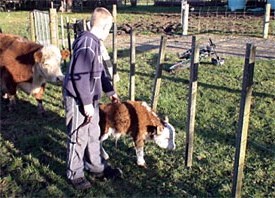
live births, one bull and one heifer. The heifer Amy (picture to
the right at three months), has made it worth while as she is tiny,
just what we are looking for.
You
may have noticed our new logo and name, Mini Moos at the top of
the page. It is now a registered trademark and it reflects the aim
of our breeding program. Last season we used our small bull Robbie
over most of the herd and also did a bit of embryo work using two
cows and a rented bull, Hamish. Hamish was a little on the large
side for us, but he had a very gentle temperament. His head and
shoulders had curly hair just like a buffalo. The embryo work was
nothing fantastic, only two embryo, but fortunately both produced
live births, one bull and one heifer. The heifer Amy (picture to
the right at three months), has made it worth while as she is tiny,
just what we are looking for.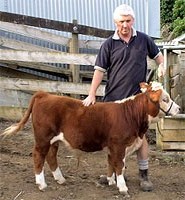 Riverview
Zorro"The females in your herd are where you are now,
the bull is the future"
Riverview
Zorro"The females in your herd are where you are now,
the bull is the future"


 Bryon
will be for sale shortly. He is a proven bull with a really good
mane and is 108cm high at the hips.
Bryon
will be for sale shortly. He is a proven bull with a really good
mane and is 108cm high at the hips.